
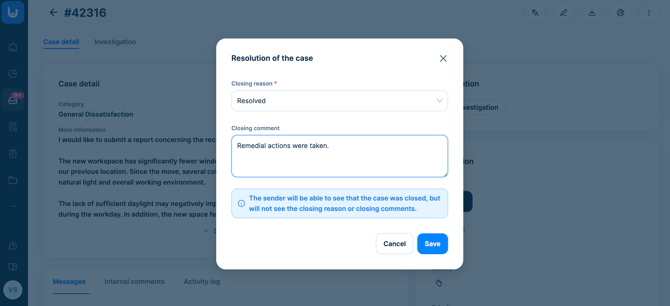
When you change a case status to Closed, FaceUp will automatically prompt you to fill in:
-
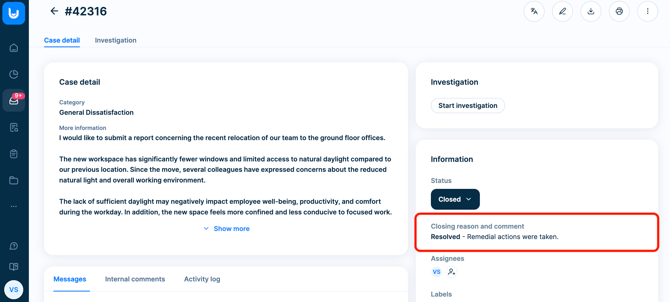
Closing reason
-
Closing comment
This step is mandatory and ensures your case documentation is complete, structured, and audit-ready.
Importantly, this information is internal only.
It is not visible to the report sender and can only be accessed by members of your FaceUp administration team.
Tip: You can define your own closing reasons or edit the existing ones - see the Managing closing reasons for more information.
Filtering cases by closing reason
Once cases are closed with a defined reason, you can easily filter cases in the Cases overview.
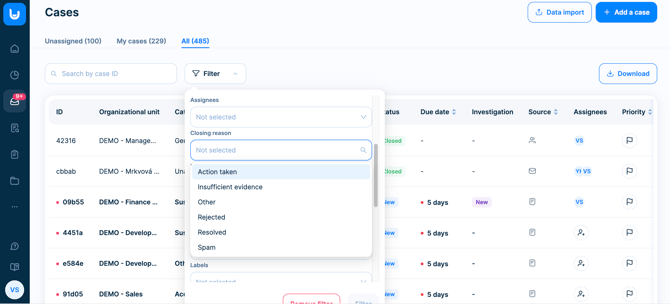
This is particularly useful if you want to analyze, for example:
-
Substantiated vs. unsubstantiated cases
-
Policy breaches vs. misunderstandings
-
Cases resolved through mediation vs. disciplinary action
Closing reasons in Analytics
In the Analytics section, you’ll find a visual chart displaying case distribution by closing reason.
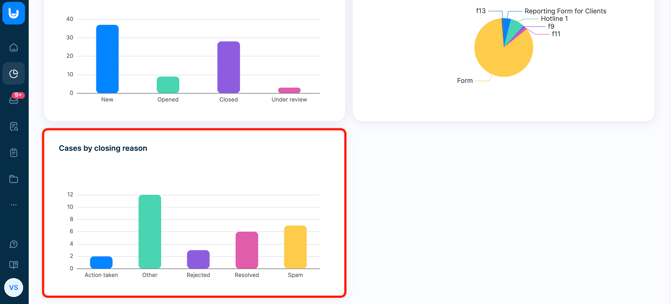
This allows you to:
-
Quickly understand resolution trends
-
Share high-level summaries with leadership
-
Identify recurring compliance risks
-
Spot areas where additional training or policy updates may be needed
Why closing reasons matter
For compliance and ethics leaders, closing a case is more than an administrative action - it’s a signal.
Clearly defined closing reasons help you:
-
Maintain consistent case documentation across your team
-
Ensure audit-readiness and defensibility
-
Identify patterns in resolution types
-
Track how issues are handled over time
-
Improve reporting to leadership and the board
Instead of simply marking a case as closed, you create structured insight into how and why it was resolved.
Best practice for compliance teams
We recommend:
-
Defining clear internal guidelines for selecting closing reasons
-
Keeping closing comments factual and audit-ready
-
Reviewing closing-reason analytics quarterly
-
Aligning resolution categories with your compliance reporting framework
When used consistently, closing reasons turn your case management process into a strategic compliance asset - not just a record-keeping tool.