---
title: What is the Investigations module
description: The Investigations module is designed to help organizations, and individual case managers, handle cases and investigations in a more structured, documented way, all directly inside FaceUp.
---
[Skip to content](https://support.faceup.com/what-is-the-investigation-module#main-content)
- [English](https://support.faceup.com/what-is-the-investigation-module)
- [Čeština](https://support.faceup.com/cs/what-is-the-investigation-module)
English
Show submenu for translations
[Contact Support](https://support.faceup.com/kb-tickets/new?hsLang=en)
[](https://www.faceup.com/en)
- [Help center](https://support.faceup.com/en)
- [System status](https://status.faceup.com/)
- [Trust Center](https://trust.faceup.com/)
Open main navigation
Close main navigation
- [Help center](https://support.faceup.com/en)
- [System status](https://status.faceup.com/)
- [Trust Center](https://trust.faceup.com/)
- - [English](https://support.faceup.com/what-is-the-investigation-module)
- [Čeština](https://support.faceup.com/cs/what-is-the-investigation-module)
English
Show submenu for translations
- [Contact Support](https://support.faceup.com/kb-tickets/new)
- [Sign In](https://www.admin.faceup.com/)
[Sign In](https://www.admin.faceup.com/)
How can we help you?
- There are no suggestions because the search field is empty.
1. [FaceUp Help Center](https://support.faceup.com/?hsLang=en)
2. [Administration features](https://support.faceup.com/administration-features?hsLang=en)
3. [Investigations](https://support.faceup.com/administration-features?hsLang=en#investigations)
# What is the Investigations module
The Investigations module is designed to help organizations, and individual case managers, **handle cases and investigations in a more structured, documented way**, all directly inside FaceUp.
Whether you're **a case manager** working through cases on your own, **a compliance or HR team running formal investigations** with dedicated investigators and legal teams, this module is built to support both.
Rather than relying on spreadsheets, emails, and scattered tools, you can manage the entire process, from initial report and evidence collection to final resolution — in **one centralized workspace** **that keeps everything structured, documented, and audit-ready.**
### **Why it matters**
Many organizations are already investigating cases, formally or on an ad-hoc basis, often without the right tools to do it well. The **Investigation Module is built to fix that**, not to convince you to add formal investigations to your policy.
It helps with:
- **Scattered evidence.** No more emails, drives, and spreadsheets with no single source of truth.
- **Manual workload.** Less time spent chasing down evidence and writing reports by hand.
- **Audit anxiety.** A tamper-proof activity log instead of a document hunt when proving a fair process.
- **Security exposure.** Sensitive identities and files stay restricted to the people who need them.
### **When to use the Investigation Module?**
The Investigation Module is best suited for cases that call for a **more structured, formal process**. This includes situations such as:
- Serious misconduct, such as harassment, fraud, or ethics violations
- Cases that may require audit or legal review
- Investigations involving multiple stakeholders
- Cases that require gathering and organizing evidence
- Situations where you need to track the case history as it evolves
- Investigations where multiple investigators need a secure, shared space to collaborate and document findings
For simpler cases like a one-off complaint, a minor policy question, or a straightforward HR request, standard case management is usually sufficient.
If you want a more structured approach for any case, the Investigation Module works for that too. It's designed to give you a clear process trail and audit-ready documentation throughout.
### **Why use the Investigation Module?**
Without a dedicated workspace, investigations quickly become messy. Evidence gets scattered across emails, findings go undocumented, and sensitive information reaches the wrong people.
#### The Investigation Module helps you:
- Keep all evidence, plans, and findings in **one secure place**.
- **Protect reporter identities** with strict, role-based access control.
- Maintain a **tamper-proof activity log** throughout the process.
- **Collaborate** with investigators, legal, and HR without losing control.
- Generate a **clear, professional, and court-ready PDF report** in one click.
With Investigations, your team can **move faster while staying compliant** - and always have a single source of truth for every case.
### **Who can access and manage investigations?**
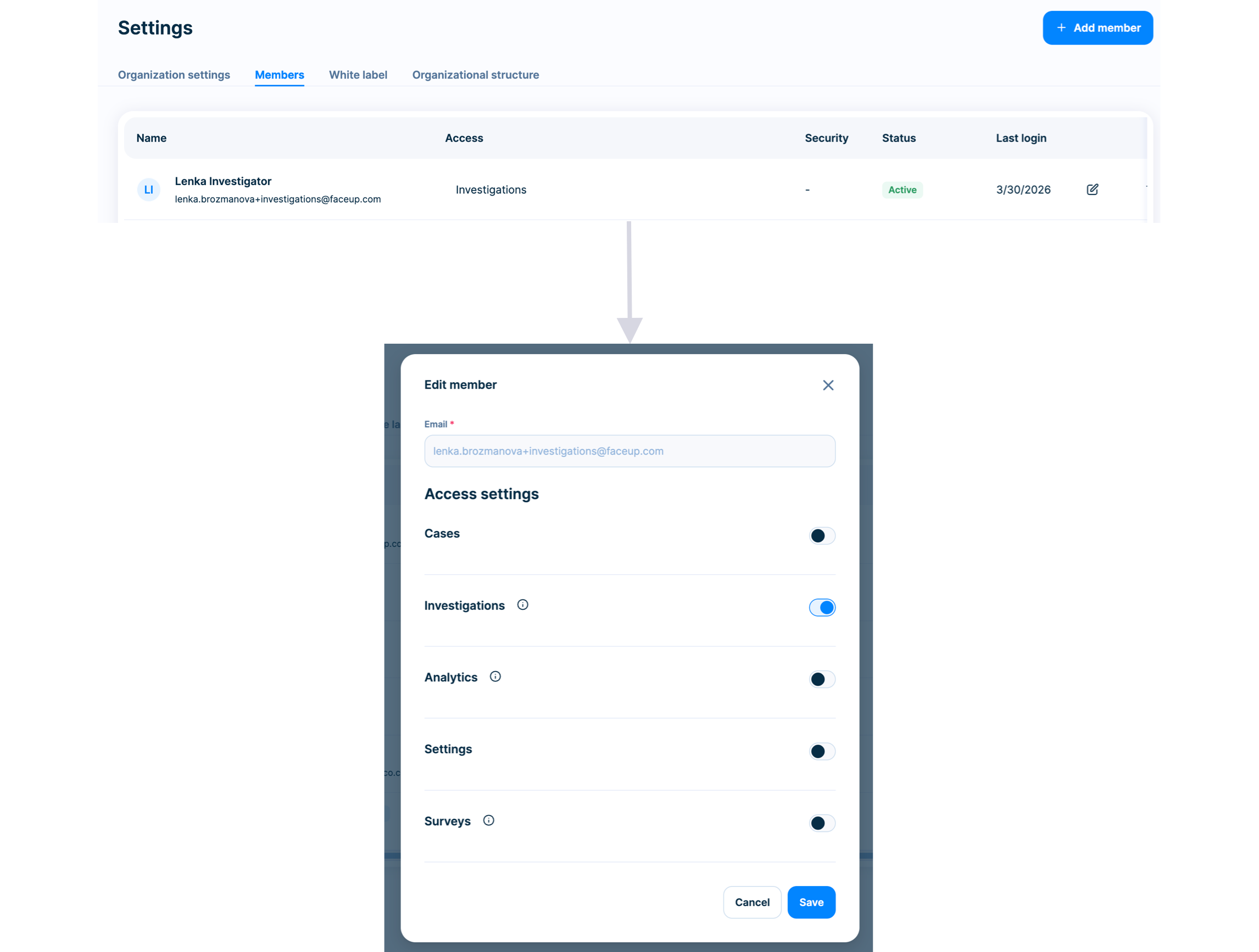
Investigations are only accessible to users with the appropriate permissions, which can be managed in the **Members** section of your account.
This is particularly useful if you invite an external investigator, legal advisor, or HR professional, since you can give them access to investigation content only, without exposing the rest of your account.
#### Here's how access works in practice:
- All investigators can view the list of investigations in the Investigations section
- Only assigned investigators can access the details of a specific investigation
- If you create an investigation but are not assigned as an investigator, you will only see basic information (such as status) and will not have access to investigation details
This ensures sensitive information is properly restricted and handled securely.
### **Best practices**
To get the most out of the Investigation Module:
- Assign investigators immediately → this avoids delays and unclear ownership
- Set a due date → it keeps investigations moving and prevents them from stalling
- Use evidence metadata consistently → it makes reviews and audits faster
- Add summaries and recommendations → it improves the quality of final reports
- Treat the investigation as a single source of truth → this prevents fragmentation across tools
- [General](https://support.faceup.com/general?hsLang=en)
- [Administration features](https://support.faceup.com/administration-features?hsLang=en#main-content)
- [Managing cases](https://support.faceup.com/administration-features?hsLang=en#managing-cases)
- [Investigations](https://support.faceup.com/administration-features?hsLang=en#investigations)
- [Managing members](https://support.faceup.com/administration-features?hsLang=en#managing-members)
- [Settings](https://support.faceup.com/administration-features?hsLang=en#settings)
- [Channels](https://support.faceup.com/channels?hsLang=en#main-content)
- [Form](https://support.faceup.com/channels?hsLang=en#form)
- [Automated hotline](https://support.faceup.com/channels?hsLang=en#automated-hotline)
- [AI-powered Hotline](https://support.faceup.com/channels?hsLang=en#ai-powered-hotline)
- [Live hotline](https://support.faceup.com/channels?hsLang=en#live-hotline)
- [Survey](https://support.faceup.com/channels?hsLang=en#survey)
- [Integrations](https://support.faceup.com/integrations?hsLang=en#main-content)
- [HR Systems & Employee Sync](https://support.faceup.com/integrations?hsLang=en#hr-systems-employee-sync)
- [Notifications & Communication Tools](https://support.faceup.com/integrations?hsLang=en#notifications-communication-tools)
- [Automation & Workflow Tools](https://support.faceup.com/integrations?hsLang=en#automation-workflow-tools)
- [API & Advanced Integrations](https://support.faceup.com/integrations?hsLang=en#api-advanced-integrations)
- [Compliance & GRC Tools](https://support.faceup.com/integrations?hsLang=en#compliance-grc-tools)
- [Privacy & Security](https://support.faceup.com/privacy-security?hsLang=en)
- [Partner administration](https://support.faceup.com/partner-administration?hsLang=en)
[](https://www.faceup.com/en)
FaceUp Technology © 2025
```json
{
"@context" : "https://schema.org",
"@type" : "VideoObject",
"caption" : {
"@type" : "MediaObject",
"contentUrl" : "https://support.faceup.com/media-transcripts/433755100378/en.vtt",
"inLanguage" : "en",
"name" : "en Captions"
},
"contentUrl" : "https://26763534.fs1.hubspotusercontent-eu1.net/hubfs/26763534/video_assets/433755100378/inherited/web_optimized.mp4",
"dateModified" : "2026-07-08T15:41:17.006Z",
"duration" : "PT4M28S",
"height" : 2160,
"name" : "Investigations",
"thumbnailUrl" : "https://26763534.fs1.hubspotusercontent-eu1.net/hubfs/26763534/investigations.mp4/medium.jpg",
"uploadDate" : "2026-07-08T15:38:19.061Z",
"width" : 3840
}
```